
The Public-Sector AI Governance Toolkit: Seven Records Worth Keeping
Seven usable governance records and the fields each should contain, designed for public bodies that need control without creating a new bureaucracy.
Indicative, from main CPV
2,110 coded · 81 unclassified
By OCDS release tag
Counts are notices, not contracts.
Seven rolling 24h windows · UTC
Left: earliest · right: most recent publication interval
Ranked by published notices
Window: 12 Nov 2026–19 Nov 2026 · Updated 28 Nov, 12:15 UTC
Seven usable governance records and the fields each should contain, designed for public bodies that need control without creating a new bureaucracy.
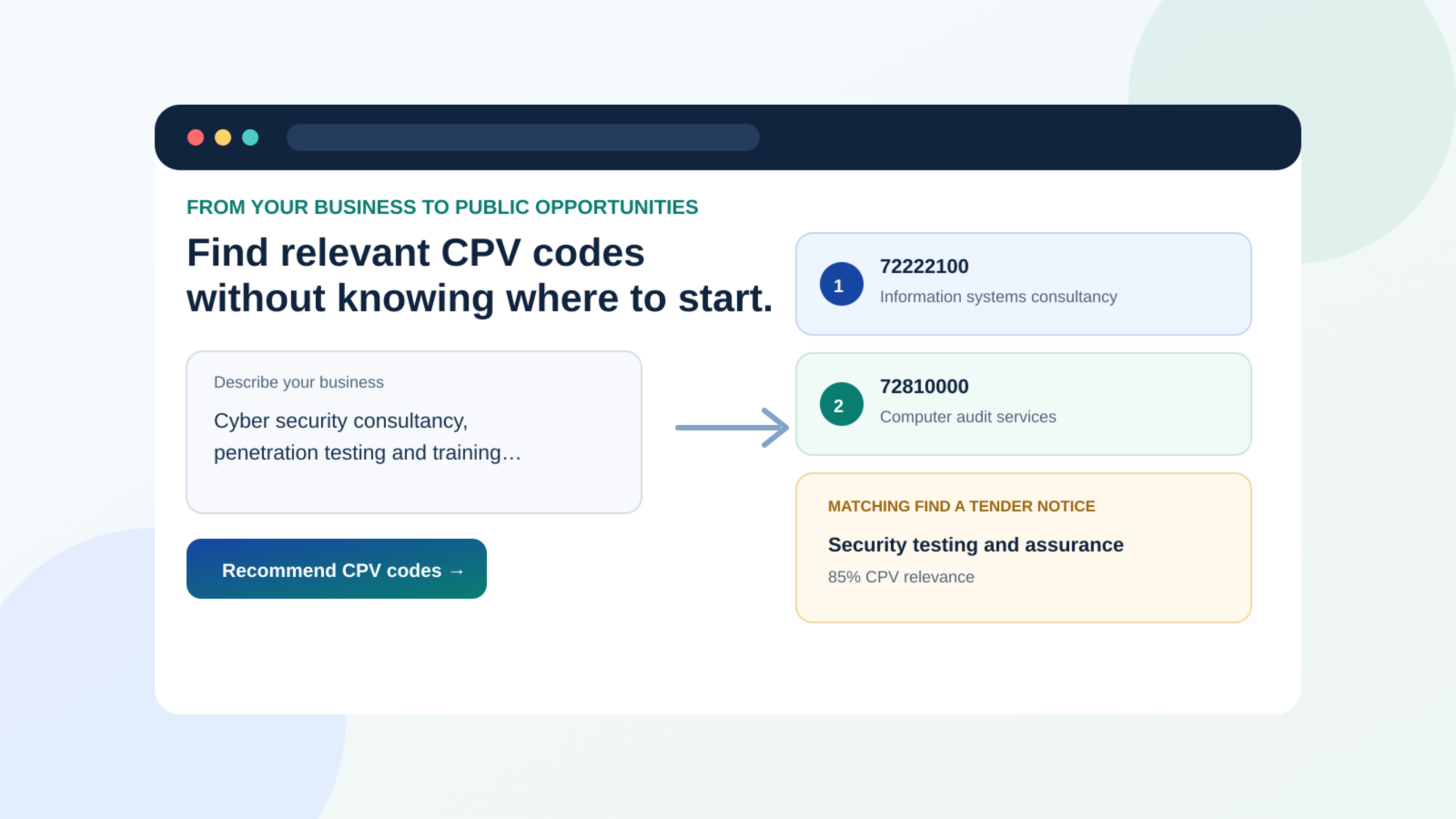
The UK public sector represents one of the country’s largest commercial markets, yet it is often presented to suppliers through classifications, notice structures…

I’ve been experimenting with a small web game recently, although calling it a game is perhaps stretching the definition a little because there…

Bayesian probability is a fascinating and powerful concept within the world of statistics and decision-making. Named after the 18th-century mathematician Thomas Bayes, this…

The AI-Assisted Discharge Summary (AI-Assisted DSUM) is a technological innovation aimed at improving the efficiency of hospital discharge summaries within the NHS. Using…

In today’s rapidly evolving healthcare landscape, Information Management and Technology (IM&T) plays a critical role in ensuring the efficient and effective delivery of…

NHS procurement is fraught with challenges ranging from complex regulatory frameworks and budget constraints to supply chain disruptions and technological limitations. The introduction…

This article originally appeared on NOECPC website linked here Data is critical for achieving the best possible outcomes in procurement negotiations and supplier…

As the UK healthcare sector strives to reduce its environmental impact, sustainable procurement is emerging as a key area of focus. By making…
Artificial intelligence is transforming how organisations operate, but deploying AI successfully requires more than selecting a model or building an application. Businesses must also address AI governance, information security, data protection, regulatory compliance, operational risk and long-term accountability.
View the book