
The Public-Sector AI Governance Toolkit: Seven Records Worth Keeping
Seven usable governance records and the fields each should contain, designed for public bodies that need control without creating a new bureaucracy.
Indicative, from main CPV
2,110 coded · 81 unclassified
By OCDS release tag
Counts are notices, not contracts.
Seven rolling 24h windows · UTC
Left: earliest · right: most recent publication interval
Ranked by published notices
Window: 12 Nov 2026–19 Nov 2026 · Updated 28 Nov, 12:15 UTC
Seven usable governance records and the fields each should contain, designed for public bodies that need control without creating a new bureaucracy.

Bayesian probability is a fascinating and powerful concept within the world of statistics and decision-making. Named after the 18th-century mathematician Thomas Bayes, this…

The AI-Assisted Discharge Summary (AI-Assisted DSUM) is a technological innovation aimed at improving the efficiency of hospital discharge summaries within the NHS. Using…

In today’s data-driven business landscape, organisations are flooded with more data than ever before. From transaction histories to customer behaviour patterns, data can…

Blade Runner, directed by Ridley Scott and released in 1982, is a film that has transcended its own medium to leave an…

As health data professionals, we face a unique set of challenges. Not only must we manage a sea of complex and sensitive data,…

A practical method for classifying AI use cases by their real-world impact, with example tiers, escalation triggers and a worked public-service scenario.
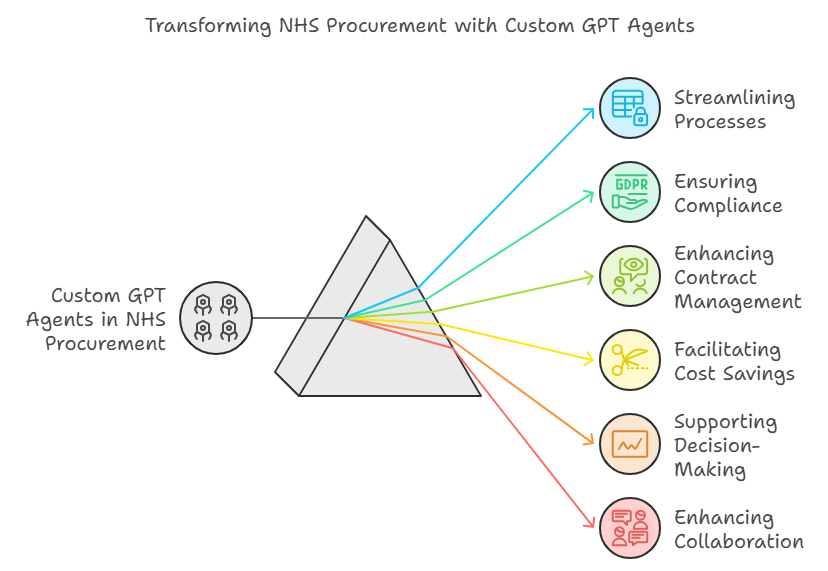
The healthcare sector, particularly the National Health Service (NHS) in the United Kingdom, operates within a complex procurement environment driven by rigorous compliance…

Introduction The National Health Service (NHS) is a cornerstone of the United Kingdom’s public sector, providing healthcare services to millions. As the NHS…
Artificial intelligence is transforming how organisations operate, but deploying AI successfully requires more than selecting a model or building an application. Businesses must also address AI governance, information security, data protection, regulatory compliance, operational risk and long-term accountability.
View the book